How to Sit
How to sit zazen
Zazen is just sitting, and it is simpler than it looks. Here is the posture, point by point, and what a morning with us holds. Read it once, and let the rest be learned on the cushion.
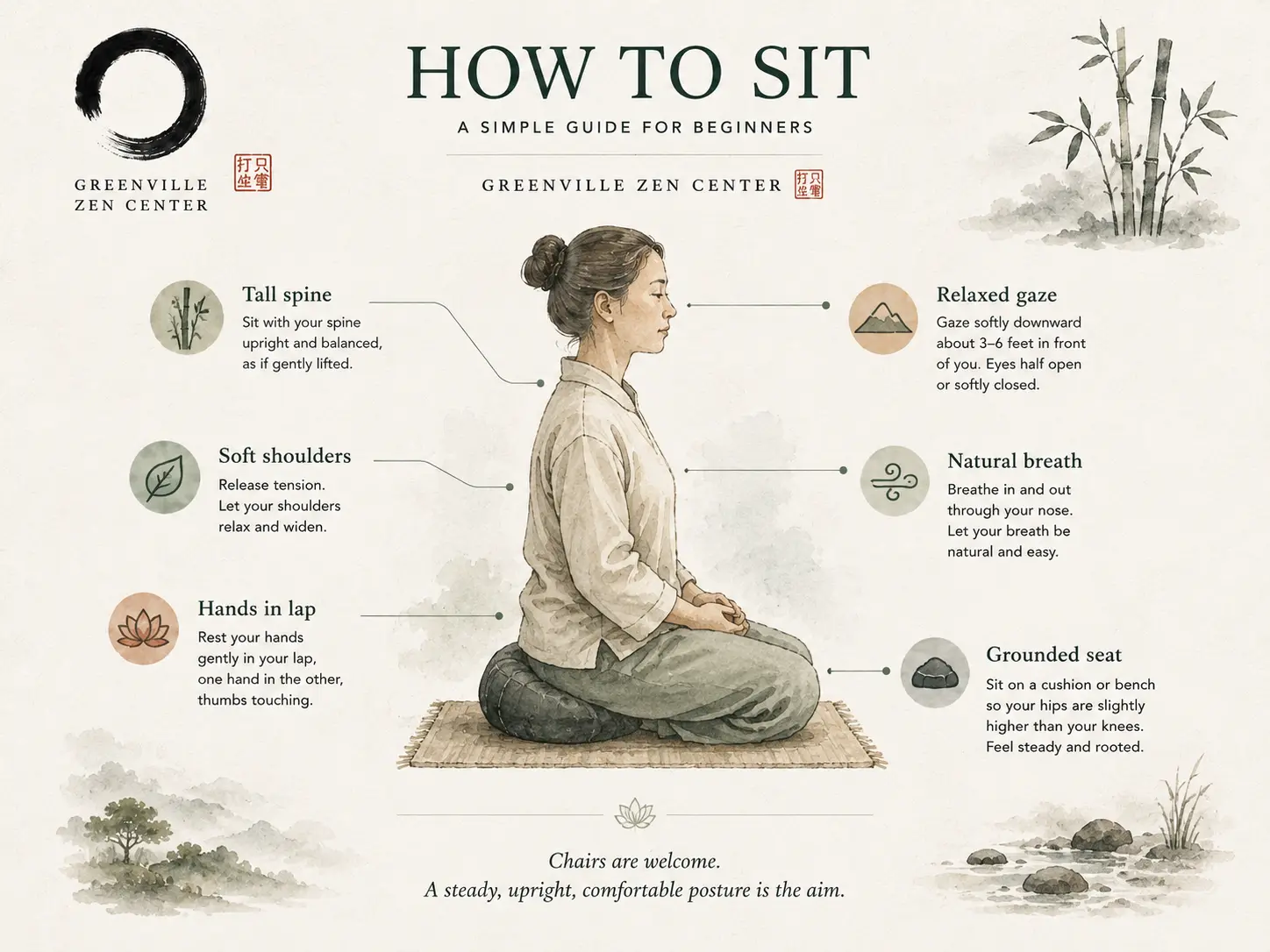
If you would rather see zazen before you read about it, here is a short introduction from Greenville Zen Center, walking through the same posture and settling we practice together. Watch it once, then let the rest be learned on the cushion.
-
Your seat
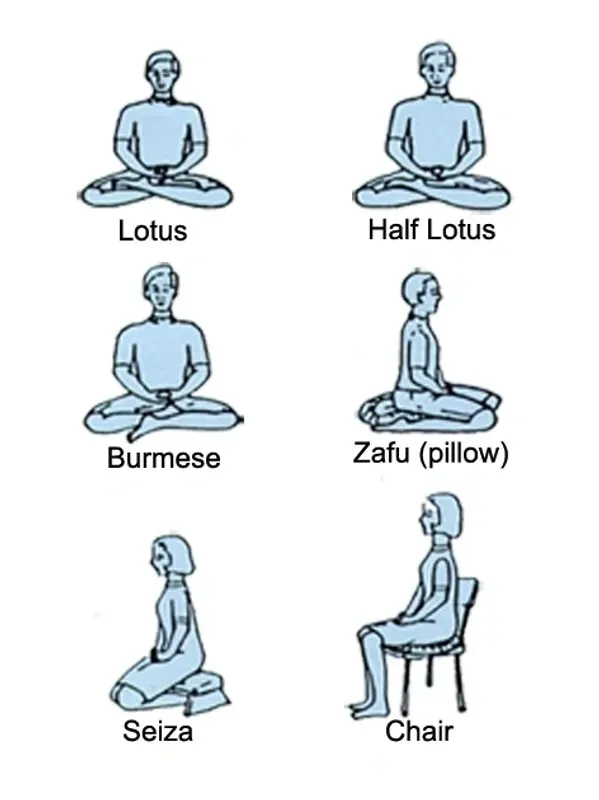
You may sit on a cushion on the floor or in a chair, and neither is more advanced than the other. On the floor, most people sit cross-legged on a firm round cushion, or kneel astride a cushion in the posture called seiza. In a chair, sit toward the front edge with both feet flat on the floor. What matters is a base that is stable and comfortable enough to hold for a while.
-
Your spine
Let your back be upright and self-supporting, lengthening gently from the base of your spine through the crown of your head, the way a mountain rests on the earth. Settle your shoulders, soften your belly, and draw your chin very slightly in. The posture is alert and dignified, awake rather than rigid.
-
Your hands
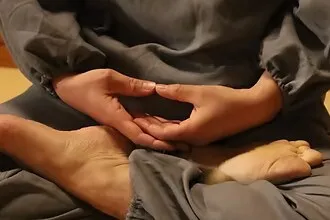
Rest your right hand in your lap, palm up, and lay your left hand in its palm, also facing up. Let the tips of your thumbs meet lightly above, forming a soft oval. This shape is called the cosmic mudra, and it becomes a small, sensitive mirror of your state: when you grow drowsy the thumbs fall apart, and when you tense they press together, so the hands themselves teach you to stay balanced.
-
Your eyes
The eyes stay open, lowered to rest softly on the floor a few feet in front of you, the gaze unfocused. Keeping the eyes open keeps you here, in the room and in your life, rather than drifting into a private dream. Many of us sit facing a blank wall, so that there is nothing to look at and nothing to look away from.
-
Your breath
Let your breathing be natural, through the nose, settling low in the belly. There is no special way to breathe. Simply let the attention ride on the breath, following each exhale as it goes out and dissolves. If it helps you settle at first, you can silently count your breaths, one through ten, beginning again at one whenever you lose the thread, which you will, often, and that is fine.
-
Your mind
Here is the part everyone worries about. You are not trying to empty your mind or to stop your thoughts, which cannot be done and is not the point. Thoughts will come, plans and memories and the whole busy parade of them. When a thought comes, let it come; when it goes, let it go, without scolding yourself and without chasing after it. Keep sitting upright, breathing, letting go. You will do this a thousand times in a single sitting, and the busy mind is no failure; the sitting itself is the practice, and there is no way to do it wrong.
You may wonder why a practice as plain as sitting comes wrapped in bows and bells and small gestures. The forms are not rules to get right, and they are not empty ceremony. They are a shared language of attention, a way of caring for the room and for one another, and a quiet means of setting the self aside for a while. We bow not to anything outside us, but to the practice itself, and to the person beside us who has also come to sit. Offered in that spirit, even the smallest gesture becomes zazen.
A few simple gestures hold the morning together. None of them are required knowledge, and no one will mind if you are a beat behind. If you are unsure, watch someone near you and follow along.
Gassho is palms together at the chest, a quiet gesture of respect and interconnectedness.
Shashu is the left hand in a soft fist with the right hand covering it, held lightly at the chest. It is how the hands rest while walking and standing.
When you enter the room, find a place. Bow in gassho to your seat, turn clockwise and bow in gassho toward the center, then take your seat. On a cushion you turn once more to face the wall; in a chair you simply settle.
The morning is kept by a few clear sounds, so you can always tell what comes next.
- Three bellsZazen begins. Sit, and let the mind and body settle.
- Two bellsRise for kinhin, slow walking meditation. Fluff your cushion, bow to your seat, and join the circle in shashu.
- One bell or a clapperKinhin ends. Bow, return to your seat, and sit once more.
- One bellThe practice period ends.
In kinhin we walk clockwise, one half-step with each breath, mindful of the breath and the feel of the floor. Kinhin is also the natural time to come or go if you need to: bow in shashu, walk out at an ordinary pace, and rejoin at a gap in the circle when you return.
At the close, we offer the merit of the morning together:
May the merit of this practice benefit all beings and bring peace.
You do not have to wait for a Sunday. A short daily sitting, even ten minutes, is a real and complete practice.
- Choose a quiet spot and a set time, even ten minutes. The same time each day helps more than a long time now and then.
- Sit on a cushion or a chair, finding the upright, settled posture above.
- Rest your hands in the cosmic mudra, lower your gaze, and let the eyes stay softly open.
- Let the breath be natural. Follow each exhale as it goes out.
- When a thought carries you off, and it will, simply let it go and keep sitting, upright and breathing.
- There is nothing to attain and no way to do it wrong. Just sit.
- When the time is up, take a breath, and carry a little of the quiet into the rest of your day.
Get the next sitting dates
One short Zen reflection, a practice for the week, and what’s happening at Greenville Zen Center. About twice a month, and you can leave anytime.
We only use your email for news about the center, and you can leave the list anytime. Read our Privacy policy.